

Key points
- The discharge method (ship's cranes or port crane) is chosen before shipment, based on weight, dimensions and the vessel.
- A precise lifting plan, with actual weight, centre of gravity and slinging points, is the basis of any operation.
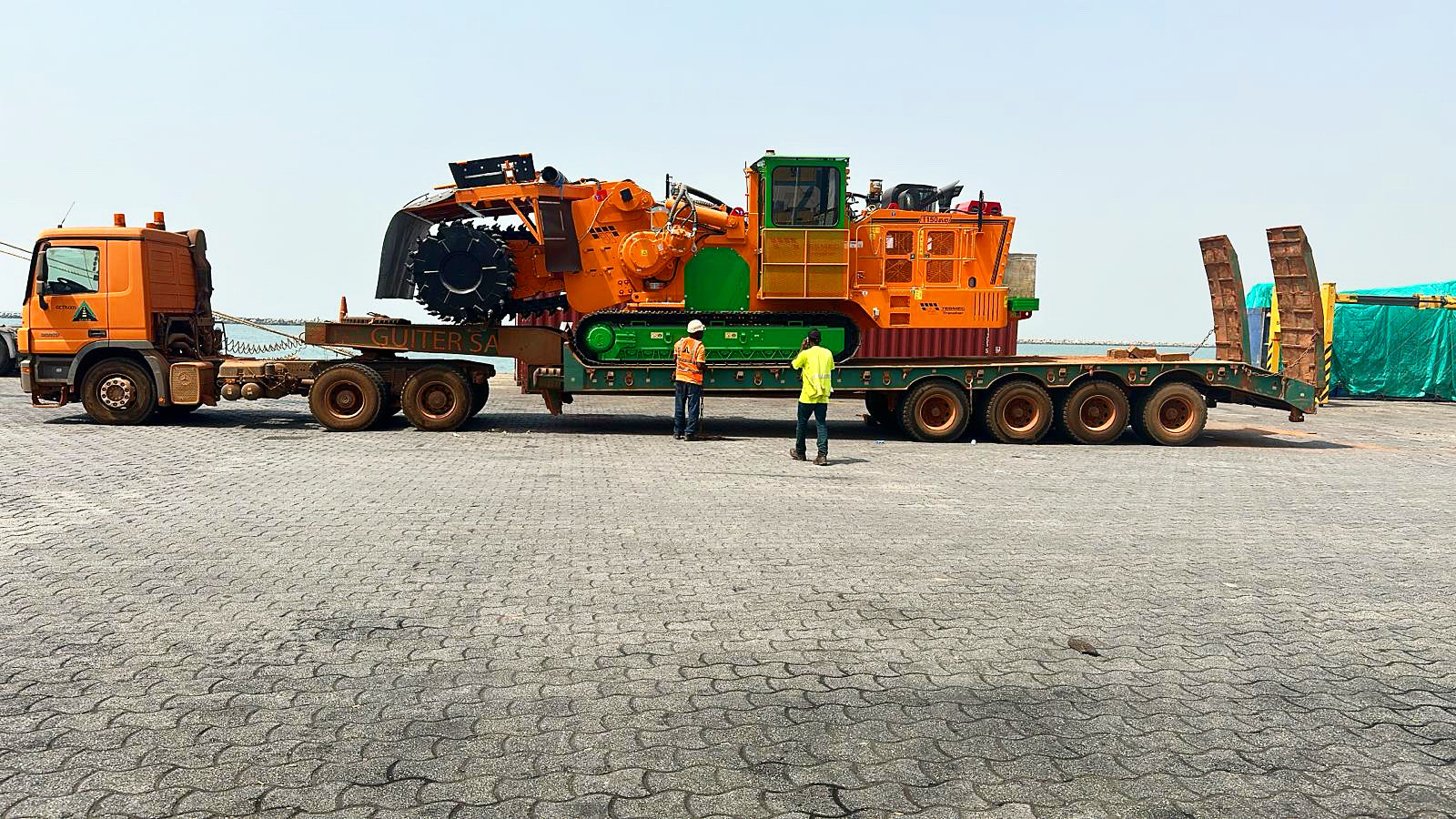
- Direct delivery from the hook to the lowbed requires the customs file and permits to be ready before arrival.
- A survey at discharge and suitable insurance protect your claim in case of damage.
How is a heavy load discharged in Conakry?
A heavy load is discharged either with the vessel's own cranes (ship's gear) or with a mobile crane from the port or a lifting contractor, depending on its weight, dimensions and the type of vessel; it is then placed on a terminal area or directly on a lowbed at the quay, then cleared and taken out of the port in convoy. The lifting method and delivery mode are chosen before shipment, not when the vessel arrives.
Such loads usually travel as breakbulk (non-containerised cargo stowed in the hold or on deck), on a flat rack (a platform with collapsible ends), or on a ro-ro vessel for self-propelled machines, which can then drive off on their own.
Ship's cranes or port crane?
- Ship's gear: many heavy-lift vessels and some multipurpose vessels have cranes able to lift large packages. This is often the simplest solution, if their capacity covers the load with the required margin.
- Mobile crane at the quay: when the vessel has no gear or its capacity is not enough, a mobile crane is brought to the quay. Its availability, positioning and the quay's bearing capacity must be confirmed in advance with the terminal.
- Ro-ro vessel: wheeled or tracked machines drive down the ramp, possibly towed for non-self-propelled loads.
A crane's real capacity depends on the radius, that is the distance between the crane and the load. A package stowed far from the ship's side or deep in the hold may require a far more powerful crane than its weight alone suggests.
The lifting plan
Every heavy lift relies on a lifting plan drawn up by a competent person and approved with the terminal and the lifting contractor.
- Actual weight of the package, packing included, and the position of the centre of gravity, given by the manufacturer and marked on the package.
- Overall dimensions and the slinging points provided by the manufacturer.
- Suitable rigging: slings, shackles, spreader beam, with their certificates.
- Positioning of the crane and the lowbed, safety zone and authorised staff.
- Weather limits, especially wind and rain.
A wrong weight or centre of gravity on the packing list is one of the most frequent causes of incidents. Require this data from the supplier at the order stage.
Lashing, securing and survey
- At departure, the package must be lashed and chocked according to sea transport rules, and its packing must protect sensitive parts from seawater and impacts.
- On arrival, inspect the package on board or at discharge: condition of packing and lashing, signs of impact or corrosion.
- Call in a marine surveyor for a high-value package, to record its condition at discharge and, if needed, the cause of any damage.
- On the lowbed, secure the package with suitable chains and tensioners, chock it and check the lashing before leaving the port.
Direct delivery at the quay or via the terminal
Two options exist, depending on the file and the port's organisation.
- Direct delivery (under hook): the package is placed straight from the hook onto the lowbed and leaves the port. This avoids double handling and storage, but requires the customs file, payments and convoy permits to be ready, or a direct removal to be authorised under the procedure in force.
- Via a terminal area: the package is placed on the area, cleared, then picked up again by a crane to be loaded onto the lowbed. This is more flexible, but adds a handling operation and storage beyond the free time.
In both cases, the lowbed must suit the weight and dimensions of the package, and abnormal load permits must be obtained before leaving the port.
Coordination with the terminal, customs and the insurer
- Send the shipping line and the terminal, before arrival, the package drawing, its weight, its centre of gravity and the lifting plan.
- Book the lifting equipment and the lowbed for the planned discharge date.
- Prepare the customs declaration before arrival, with a precise description and the right HS code, and organise the inspection if required.
- Obtain the convoy permits for the route to the site.
- Check that the insurance policy covers discharge, lifting and road transport to the site.
- Record written reserves in case of observed damage, before signing the delivery note.
What we do for you
TransXpress prepares the arrival of your heavy load with the shipping line, the terminal and the lifting contractor, clears the goods at the port of Conakry, and organises the lowbed and the convoy to your site. Send us the drawing of the package with weight, dimensions and centre of gravity, the type of vessel and the delivery location.
Frequently asked questions
Who provides the crane to discharge a heavy load?
The vessel if its own cranes are sufficient, otherwise a mobile crane at the quay arranged by the terminal or a lifting contractor. The choice is made before shipment.
Can the package be loaded straight onto a truck at the quay?
Often yes, if the customs file, payments and convoy permits are ready, or if a direct removal is authorised under the procedure in force.
Is a surveyor needed at discharge?
For a high-value package, it is recommended: the surveyor's report protects your claim against the carrier and the insurer in case of damage.
General information guide written by TransXpress. Customs rules and procedures change: every file is checked against the documents and the regulations in force.
A heavy load to bring out of the port? Send us the drawing of the package with weight, dimensions and centre of gravity, the type of vessel and the delivery location. We call you back within 24 business hours.